Cycling in Albania: The 6 Best Routes From Alps to Riviera
Six Albania bike routes from Theth to the Llogara Pass, each with its distance, elevation gain and road surface, plus road safety, seasons and prices.
Quick links
Don't want to read all this?
We've planned 800+ cycling trips. Send your dates, fitness and group size — we'll map the route and book every night.


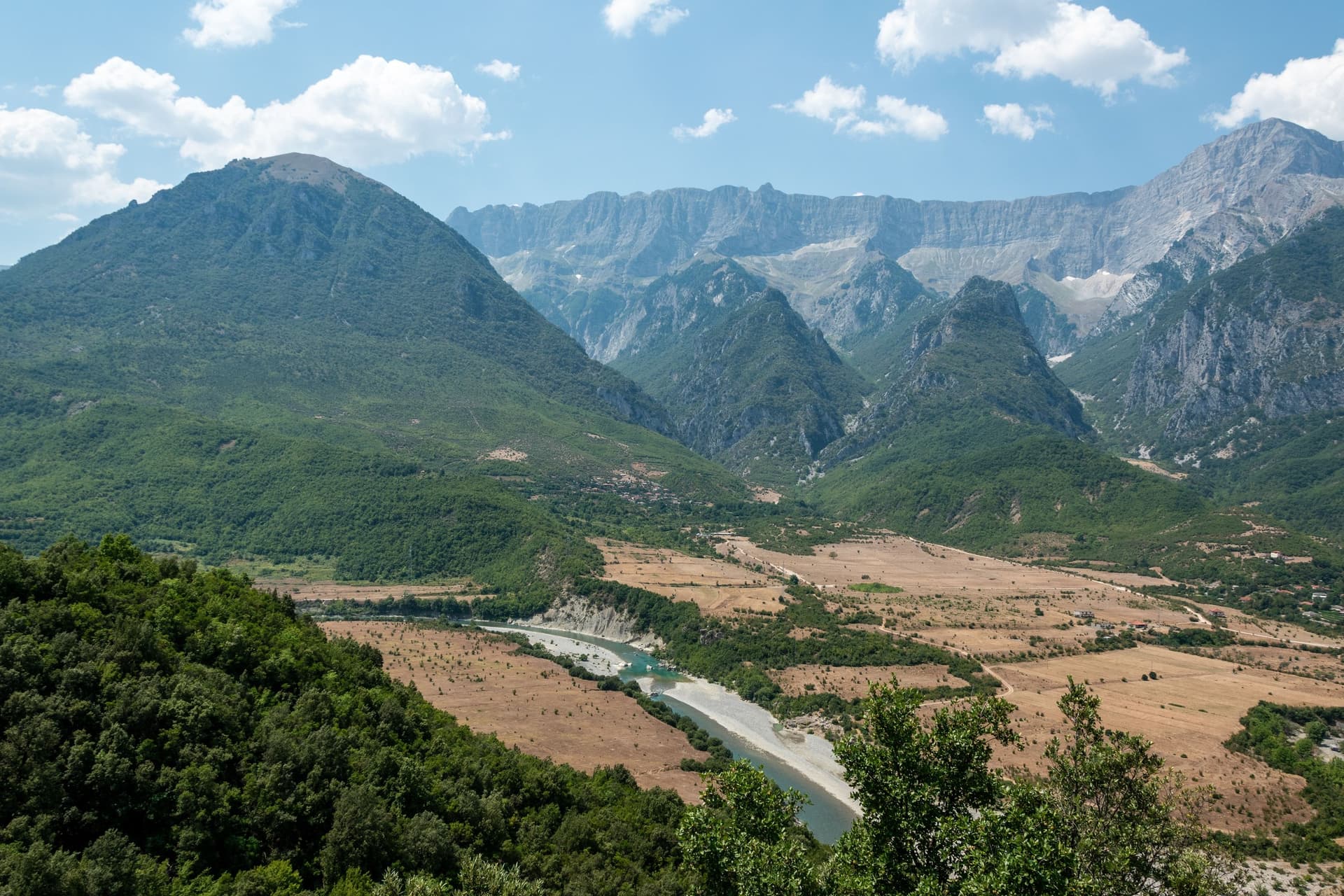
Albania puts high mountains, two large lakes and the Ionian Sea within a few days' ride of each other. In one trip you can climb into the Albanian Alps at Theth and take a ferry through the flooded gorge of the Drin. Then you finish on the Riviera, with the sea below the road.
Most of the riding is on asphalt, and away from Tirana and the summer coast the roads are quiet. Nights are in family guesthouses, where dinner is often cooked from the garden outside.
The six best cycling routes in Albania run north to south, from Theth at 750 m to the Llogara Pass at 1,027 m, and only the Vjosa valley is an easy day.
The 6 Best Cycling Routes in Albania
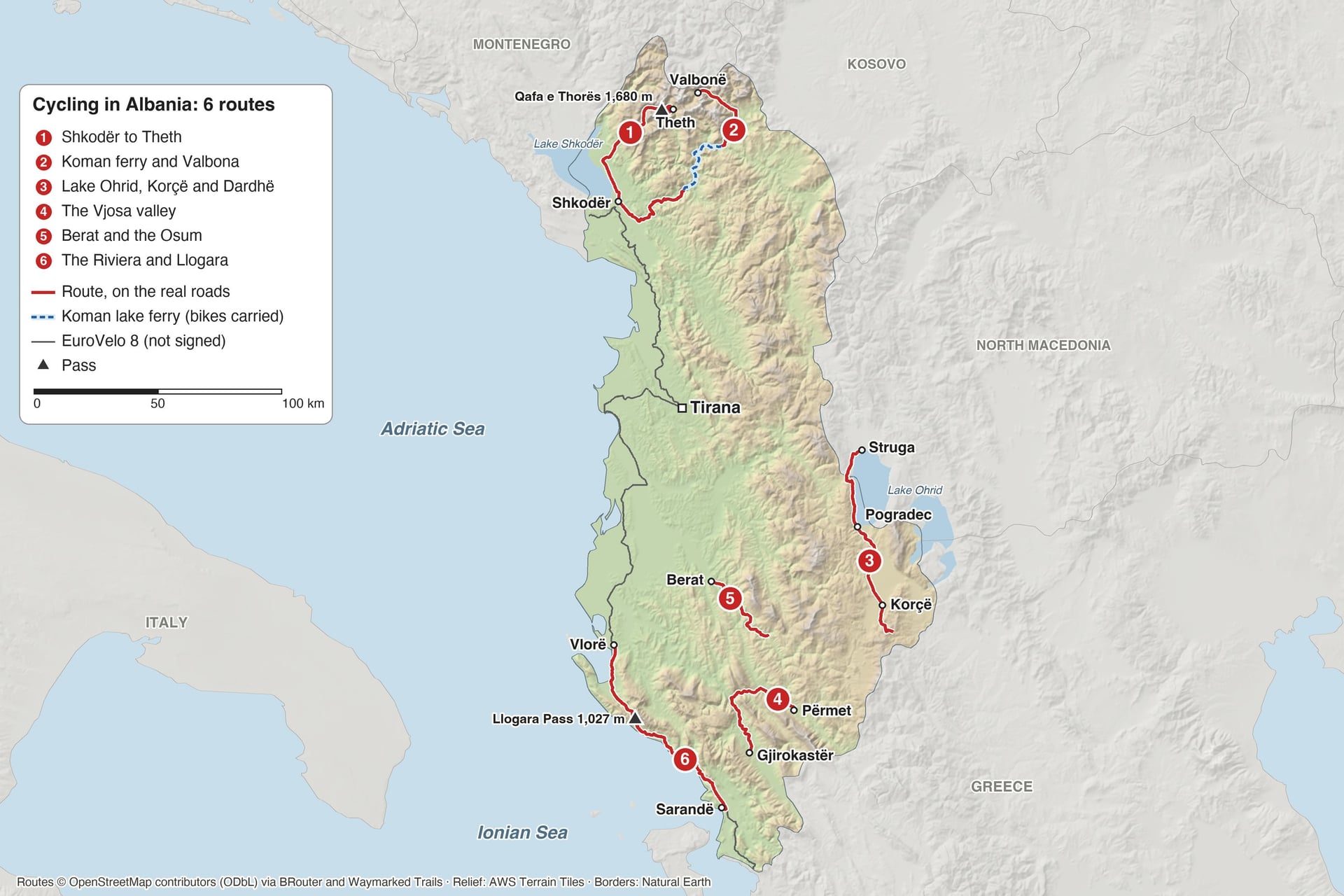
Each route has its own kind of riding: an alpine pass, a lake ferry, a high plateau, a river valley, a canyon and the coast. They are numbered from north to south, and together they cover about 540 km, 32 of them by boat.
1. Shkodër to Theth in the Albanian Alps
Distance: 75 km one way, via Koplik and Bogë
Elevation gain: 1,623 m on the 41 km climb from Koplik to the pass
Highest point: 1,680 m at Qafa e Thorës
Surface: asphalt all the way into Theth, on a narrow mountain road
Where to sleep: guesthouses in Bogë and Theth
Best months: June to September
Best for: one long alpine climb and a night in the mountains
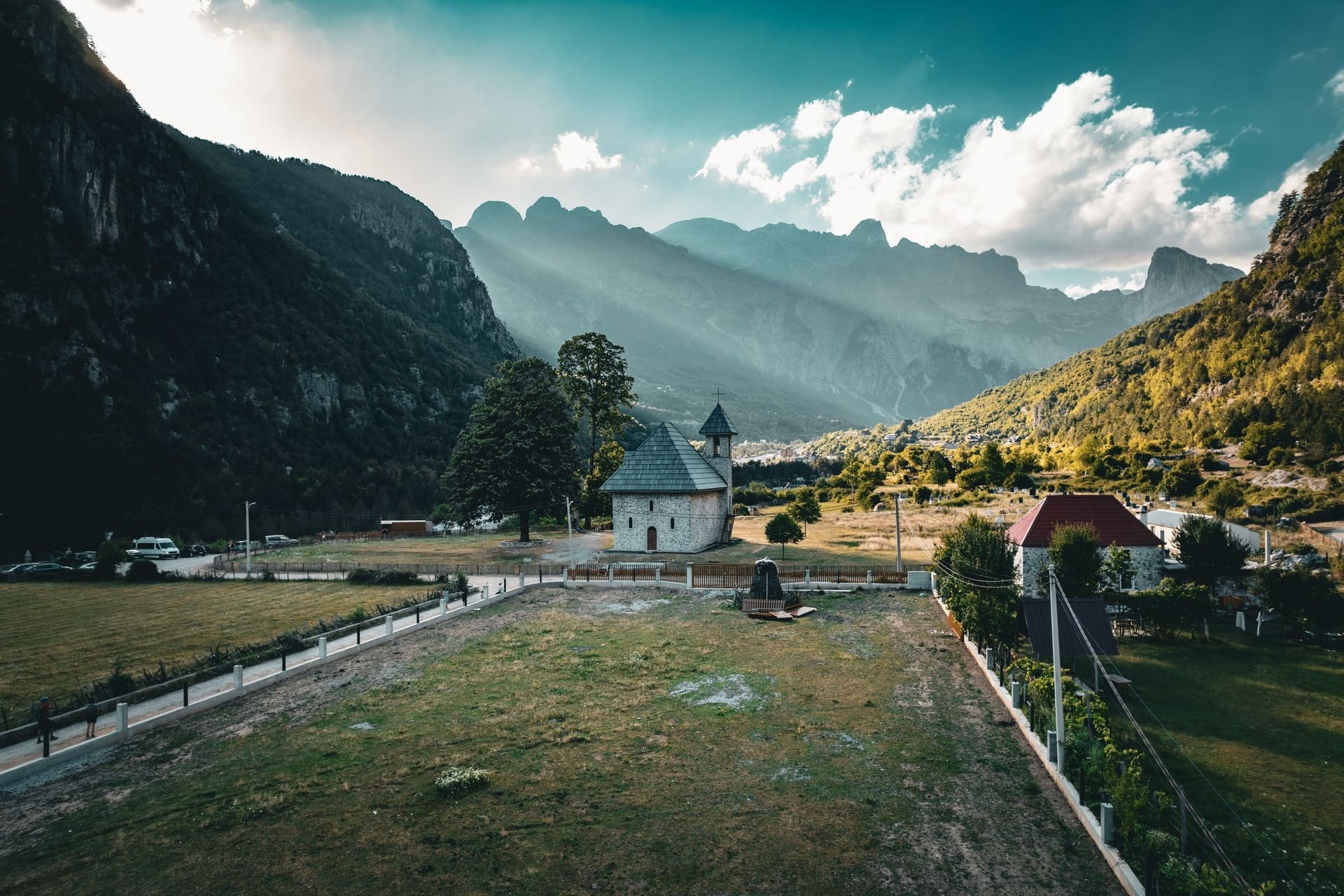
Theth is a valley of stone houses and guesthouses at about 750 m, closed in by the limestone peaks of the Albanian Alps. The SH21 runs flat from Shkodër to Koplik, then climbs for 41 km at an average of 3.9% to Qafa e Thorës, the longest steady climb in this list.
The hardest part comes last: from Bogë the road gains about 714 m in 11 km to the pass, an average of 6.5%. It is narrow and mostly single-lane, so start early to reach the top before the minibuses.
The descent is now asphalt to the village, 16 km of hairpins that drop about 940 m. Snow usually closes the pass from November to April or May, and most riders sleep in Theth and ride back the same way.
The only other way out is a track over the Mali i Shoshit pass. The Trans Dinarica's Albanian stages list it as 84% unpaved over 30 km, a job for a gravel bike.
2. Lake Koman Ferry and the Valbona Valley
Distance: 52 km from Shkodër to Koman, 32 km by ferry to Fierzë, then 40 km to Valbonë
Elevation gain: about 870 m to Koman, then about 1,100 m from Fierzë to Valbonë
Highest point: about 930 m at Valbonë
Surface: asphalt throughout; the first kilometres out of Shkodër are busy
Where to sleep: Koman, Bajram Curri and guesthouses in the Valbona valley
Best months: May to October; the Berisha ferry sails daily from 15 April to 5 November
Best for: a day on the water, then a quiet climb
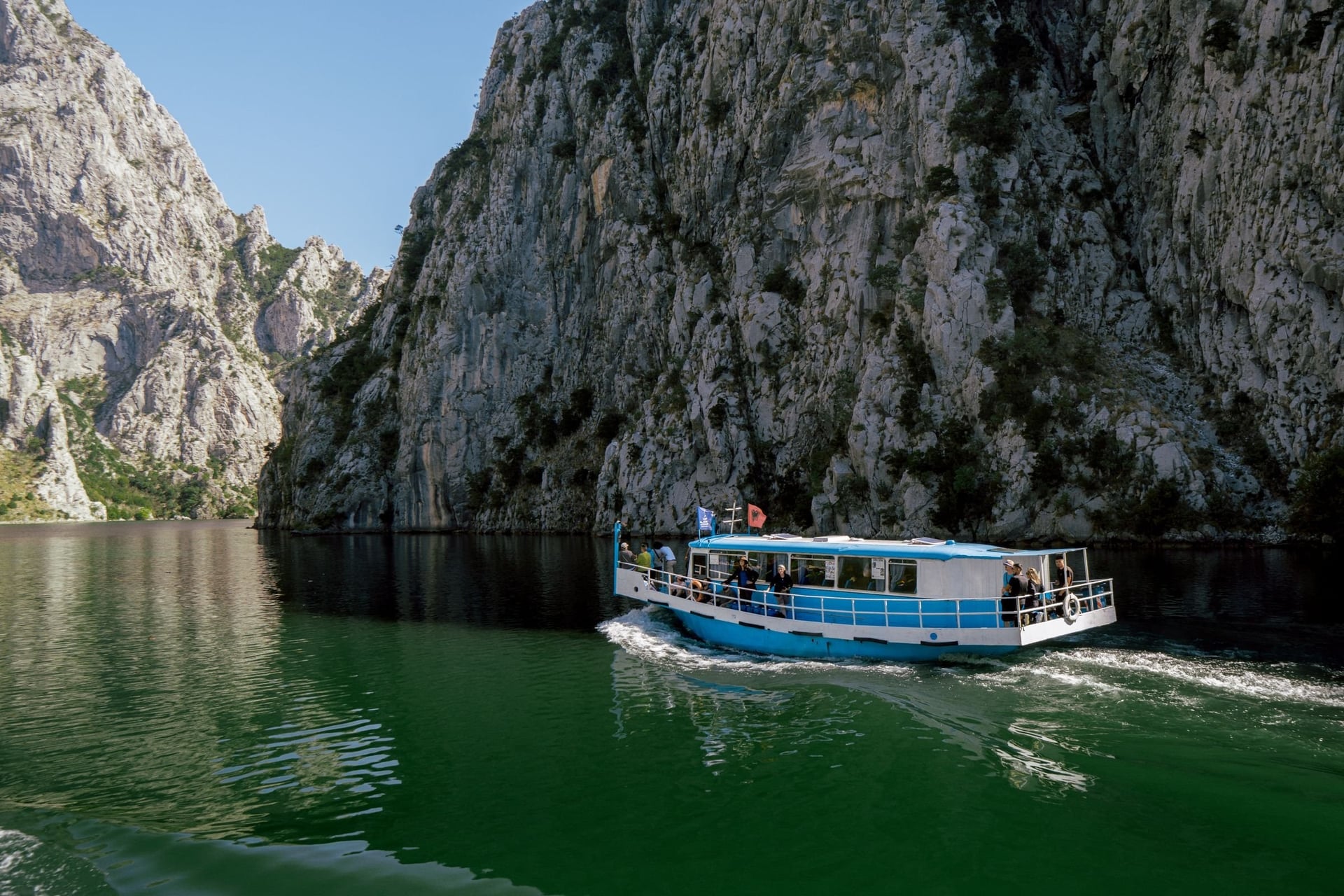
Lake Koman fills the gorge of the Drin for 32 km, and the boat ride through it is the most unusual stage in Albania. The Berisha ferry leaves Koman at 9:00 and reaches Fierzë about two and a half hours later, with bikes stowed among the cars.
Bikes check in with the vehicles 30 minutes before sailing, so you need to be at the terminal by 8:30. Shkodër is 52 km away, and many riders sleep at Koman the night before to make the boat without a dawn start.
From Fierzë the road follows the Valbona river past Bajram Curri, then climbs steadily for 40 km to Valbonë. Since 2022 the valley has been part of the Alps of Albania National Park, together with Theth, and the road ends among its peaks.
Full guide: The Trans Dinarica cycle route
3. Lake Ohrid, Korçë and Dardhë
Distance: about 100 km from Struga to Dardhë, via Pogradec and Korçë
Elevation gain: about 1,500 m, 740 m of it in the last 20 km to Dardhë
Highest point: about 1,580 m, on the ridge road just before Dardhë
Surface: asphalt throughout
Where to sleep: Pogradec on the lake, Korçë and Dardhë
Best months: May to October
Best for: a lake shore and a mountain village in two or three days
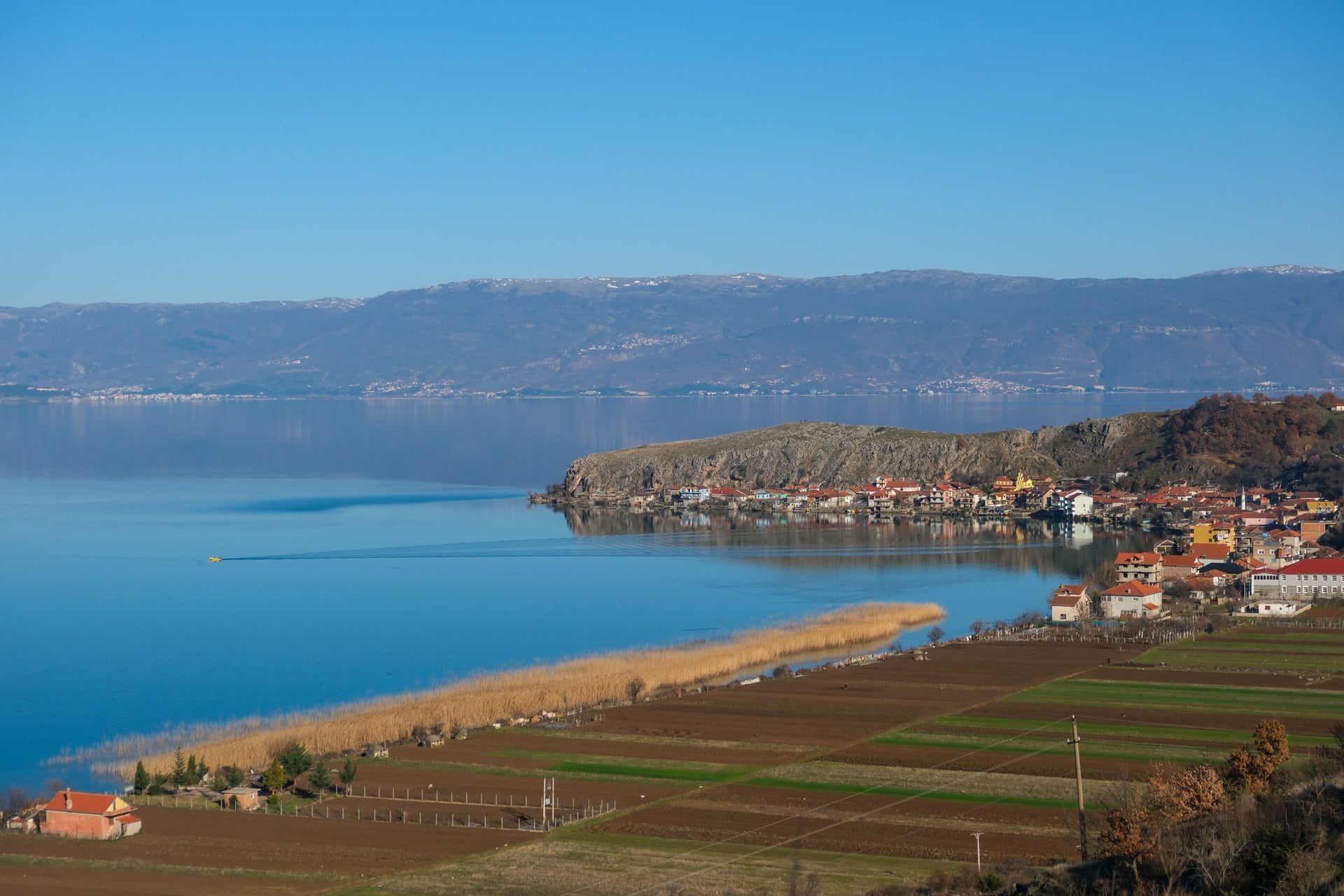
From Struga in North Macedonia the road crosses into Albania at Qafë Thanë after about 15 km, so bring a passport. It then drops past Lin to the lakeside promenade at Pogradec. Lake Ohrid is UNESCO-listed for both its nature and its culture, and the Albanian shore joined the listing in 2019.
South of Pogradec the road climbs through a gorge onto the plateau of Korçë, a town of an Orthodox cathedral and an old bazaar at about 870 m. The last 20 km climb into the Morava mountains to Dardhë, a village of stone houses well above the plateau.
The plateau keeps the days cooler than on the coast. Korçë averages 29 °C in July against 32 °C in Sarandë, and the 40 km from Pogradec to Korçë climb only about 360 m, an easy day before the climb to Dardhë.
Full guide: Cycling the Balkans
4. The Vjosa Valley: Përmet to Gjirokastër
Distance: 65 km from Përmet to Gjirokastër, via Këlcyrë
Elevation gain: about 450 m
Highest point: about 250 m, at Përmet
Surface: asphalt, mostly gently downhill beside the river
Where to sleep: Përmet and Gjirokastër
Best months: April to June, and September to October
Best for: an easy river day between mountain stages
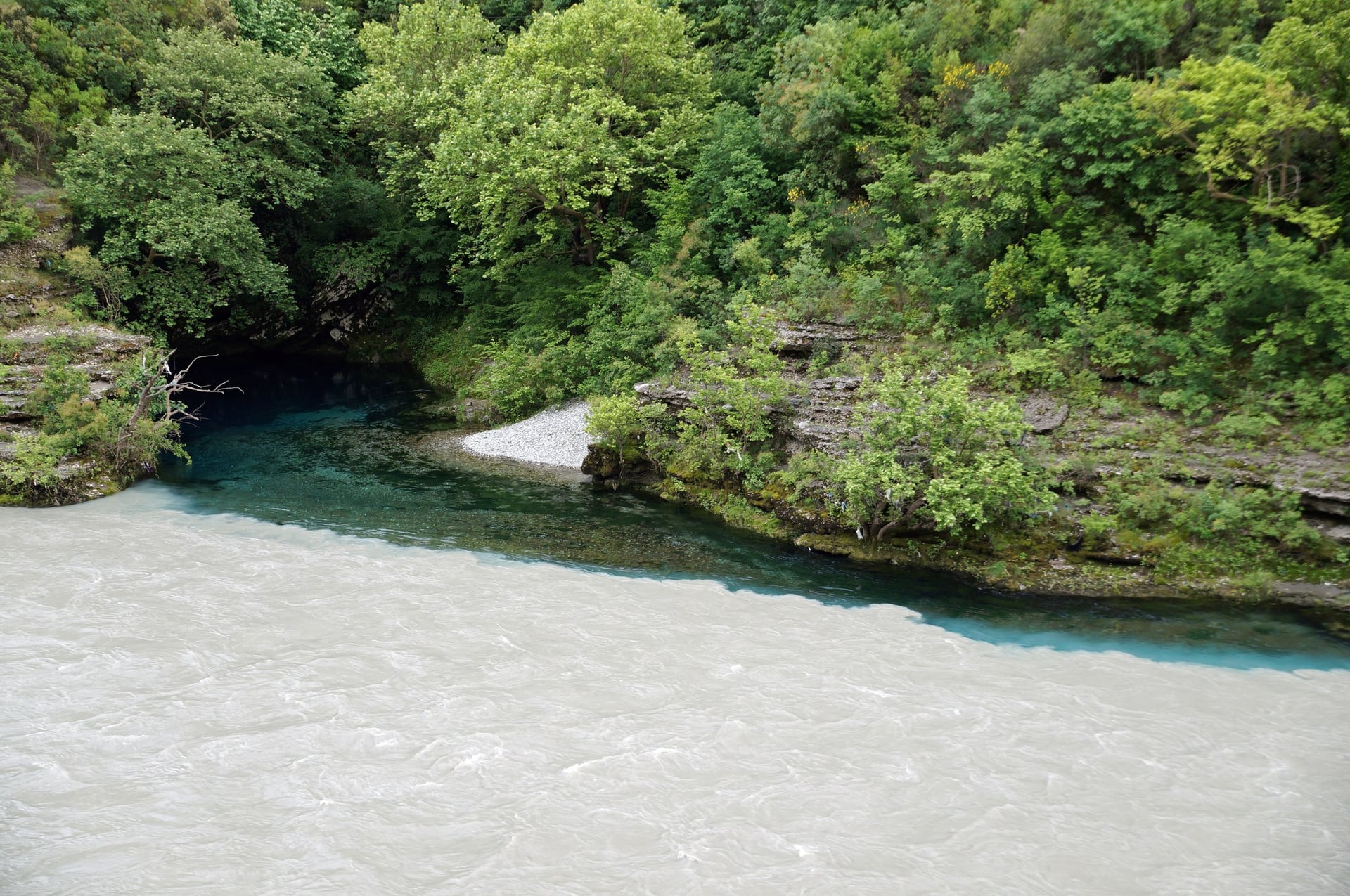
In March 2023 Albania protected the river as the Vjosa Wild River National Park, the first of its kind in Europe. The road follows the Vjosa down from Përmet, a town known for gliko, fruit preserved in syrup. The Benja thermal pools are a short detour from the town.
Past Këlcyrë the road runs through the Këlcyrë gorge to the Drinos, then turns south up that valley to Gjirokastër, a UNESCO-listed Ottoman town of stone roofs. Riders coming from Dardhë face a long link first: about 130 km with 2,000 m of climbing to Përmet.
This is the gentlest ride in the list, rolling rather than climbing, with the river beside the road for most of the day. The only real climb comes at the very end, from the valley floor up to Gjirokastër's old bazaar.
5. Berat and the Osum Canyon
Distance: about 50 km from Berat to Çorovodë, via Poliçan
Elevation gain: about 750 m
Highest point: about 340 m, at Çorovodë
Surface: asphalt to Çorovodë; gravel and broken tracks on the canyon rim
Where to sleep: Berat, and small hotels in Çorovodë
Best months: March to June, when the river runs high
Best for: a canyon with gravel side trips
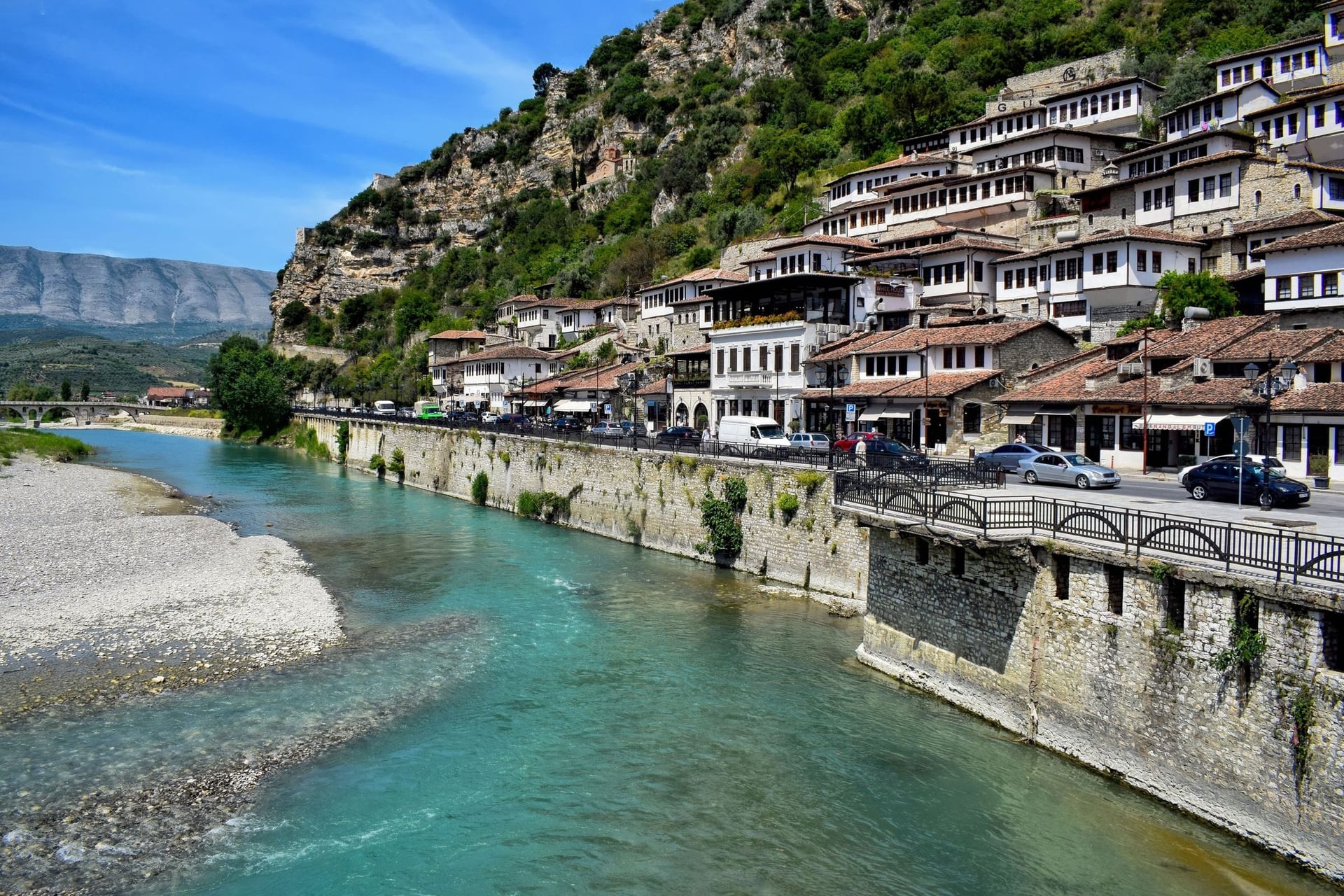
Berat's white Ottoman houses climb the hill above the Osum, and the town shares its UNESCO listing with Gjirokastër. The road south crosses the hills to Poliçan, then drops to the Osum at Bogovë and follows the river up to Çorovodë. Poliçan sits at about 330 m, so the day climbs twice: over the hills from Berat, then up the valley.
Above the town the Osum has cut a canyon 26 km long, with walls up to 80 m high. It is rafted from mid-March to early June, and the tracks along the rim suit a gravel bike better than a road bike.
From July to September the river drops low enough to walk and swim through the gorge, a good rest day from Çorovodë. The Bogovë waterfall, a short walk from the road at Bogovë, makes a stop on the way in.
6. The Riviera and the Llogara Pass
Distance: about 125 km from Vlorë to Sarandë on the SH8, over the old pass road
Elevation gain: about 2,600 m
Highest point: 1,027 m at the Llogara Pass
Surface: asphalt; the old pass road has carried little traffic since the tunnel opened in July 2024
Where to sleep: Dhërmi, Himarë and Sarandë
Best months: May, June, September and October
Best for: one big climb, then a coast road over headlands
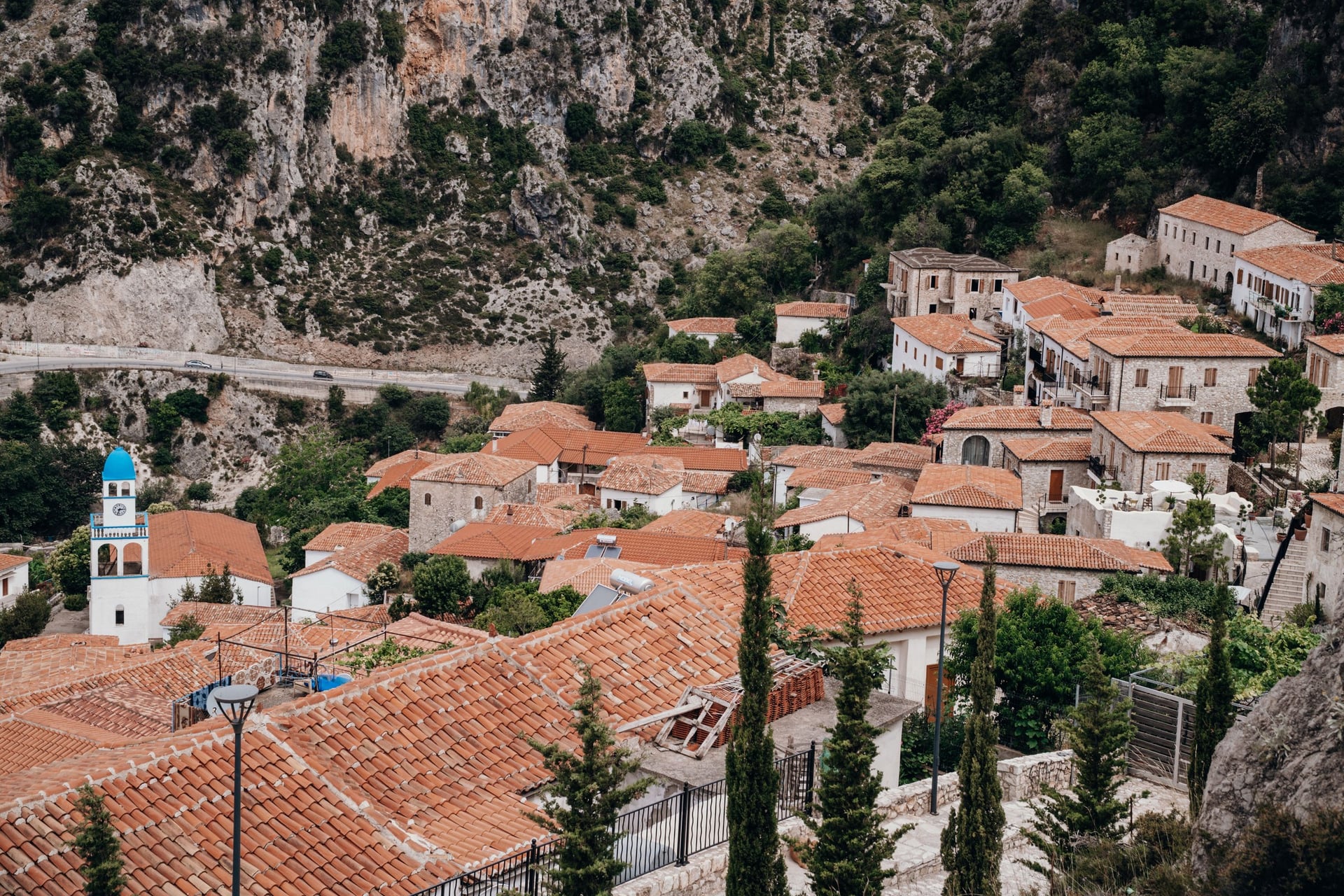
Llogara is the big climb of the coast. From Dukat on the north side it gains 861 m in 13.7 km at 6.5%. From Palasë in the south it is 16.6 km and 1,084 m, so the south side is the harder way up.
A road tunnel of about 6 km opened under the pass in July 2024, and most cars now skip the hairpins. The old road is still open, and EuroVelo 8 keeps to it.
The climbing does not end at the pass. South of Dhërmi the SH8 rolls over headlands past Himarë and the castle at Porto Palermo, and Himarë to Sarandë alone is about 55 km with 1,000 m of climbing. The Greek and Roman ruins of Butrint lie 18 km beyond Sarandë.
Full guide: EuroVelo 8 from Dubrovnik to the Greek border
Long-Distance Routes: EuroVelo 8 and the Trans Dinarica
Two long-distance routes cross Albania and share roads with these six rides, but neither is signed on the ground.
EuroVelo 8: 461 km in Albania, from Shkodër through Tirana, Durrës, Fier and Vlorë, then over Llogara to the Greek border. Only the 53 km from Fier to Orikum is graded developed on the ECF's route page, and around Durrës it shares busy main roads.
Trans Dinarica: 575 km in 11 stages with 10,210 m of climbing, 97% of it paved. It enters from Gusinje in Montenegro, crosses the Alps, takes the Koman ferry to Valbona, then runs south through Kukës and Peshkopi to Lake Ohrid.
How Hard Is Cycling in Albania?
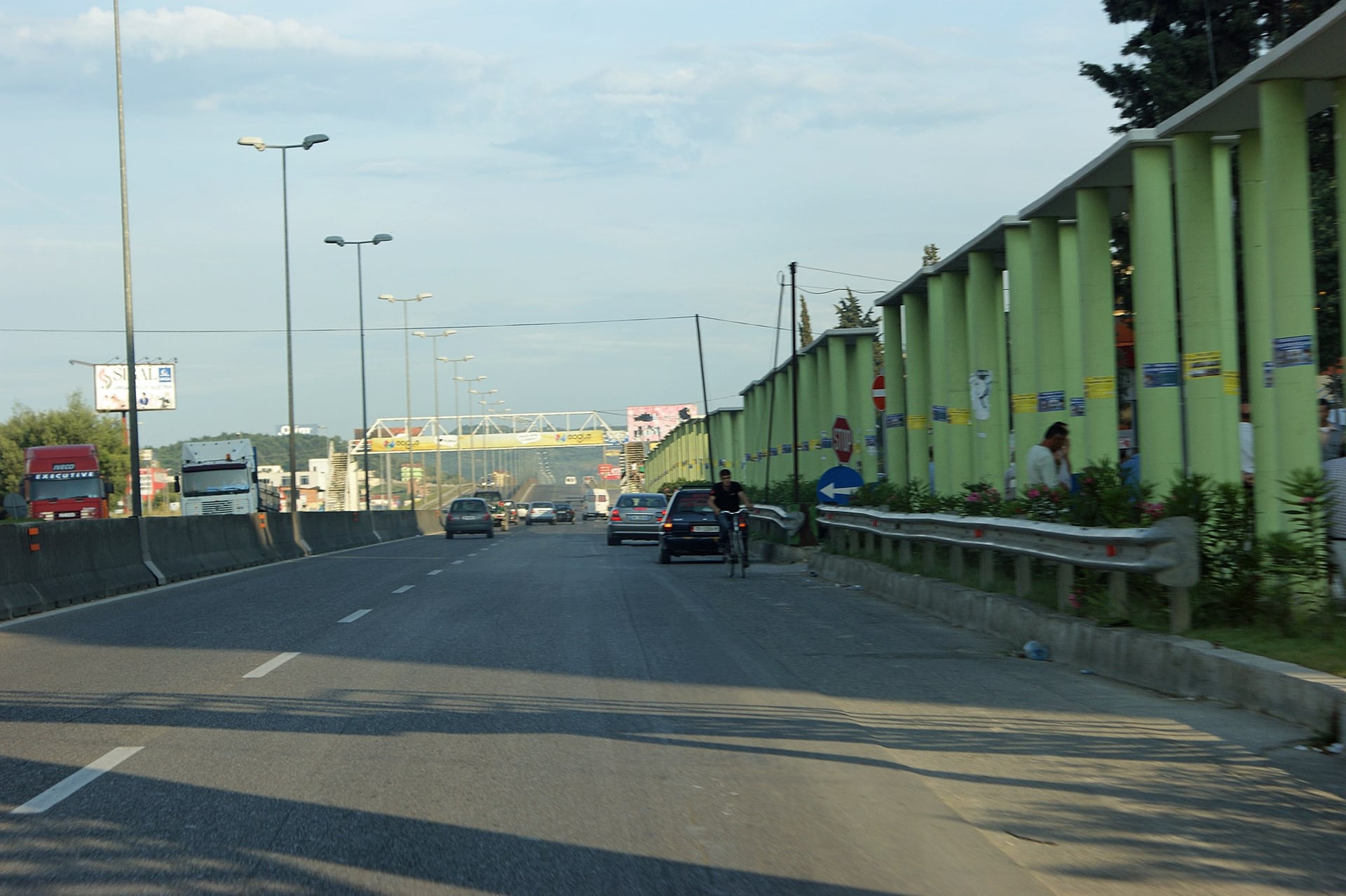
Albania is mostly mountains: every route here except the Vjosa valley gains 750 m or more.
Hills and Gradients
The climbs are long rather than steep. Koplik to Qafa e Thorës averages 3.9% over 41 km, with its steepest 100 m at 11.8%, and the north side of Llogara averages 6.5% with a maximum of 10.2%.
The hardest ramps are on Llogara's south side, where 100 m stretches reach 14%, so a loaded bike needs its lowest gears.
Road Surfaces
Albanian main roads are mostly asphalt, and new tarmac keeps replacing gravel. The Trans Dinarica team found the Peshkopi to Sebisht section paved in 2025, and 97% of its 575 km in Albania is now asphalt.
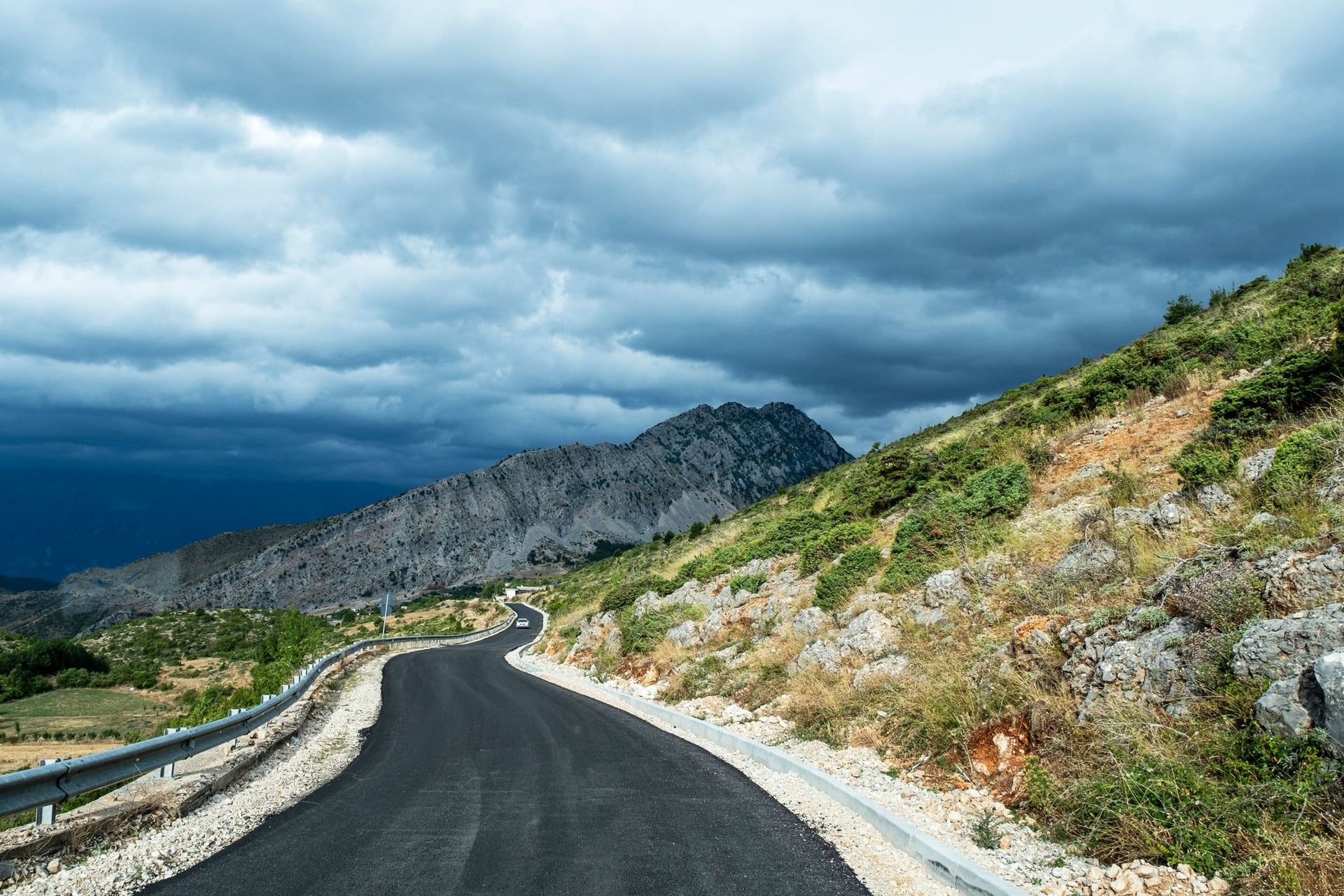
Side roads can change to broken asphalt or gravel without warning, and new roads often open before their verges are finished. Tyres of 32 mm or wider suit all six routes, and a gravel bike opens up the Osum canyon rim and the Mali i Shoshit track.
Is Cycling in Albania Safe?
Cycling in Albania is safe for riders used to sharing roads with traffic, and away from the cities most roads are quiet. In Shkodër bikes are everyday transport: private cars were illegal in Albania until 1991, and drivers there still expect bicycles on every street.
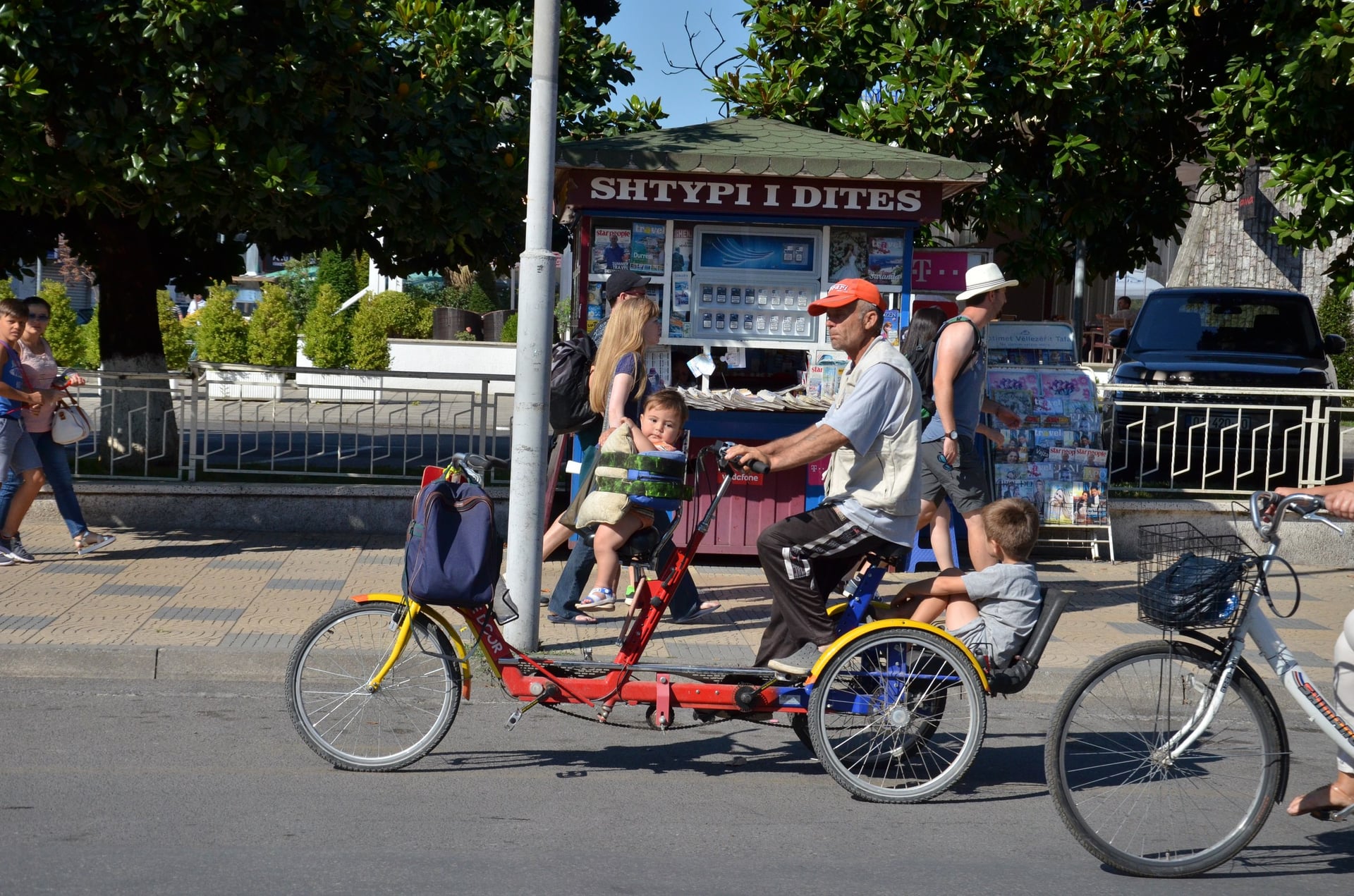
Traffic is heaviest around Tirana and Durrës and in the first kilometres out of Shkodër, so start those days early. Bicycles are banned from motorways, which are signed at the slip roads, and none of the routes here uses one.
Unlit tunnels are the other hazard, so carry front and rear lights. Most dogs are guard dogs chained at farms; if a loose one runs out, slow down and speak to it rather than sprinting away.
Waymarking and Navigation
Albania has almost no cycle route signs. EuroVelo 8 carries none on its 461 km in the country, so you ride from a GPX file on a phone or GPS unit.
Google Maps is not always reliable on rural roads. Apps built on OpenStreetMap, such as Komoot or OsmAnd, show the mountain roads, and the Trans Dinarica sells a navigation pack with GPX tracks for its 11 Albanian stages.
Best Time to Cycle in Albania
The season runs from April to October, and what changes through it is the heat in the lowlands and the snow on the northern pass.
In July and August the average high is 33 °C in Shkodër and 32 °C in Gjirokastër and Sarandë, so high summer suits the mountains better than the coast.
Average daily high (°C), 2016 to 2025:
Month | Shkodër | Qafa e Thorës (1,680 m) | Korçë (870 m) | Gjirokastër | Sarandë |
April | 20 | 7 | 16 | 19 | 19 |
May | 23 | 12 | 20 | 22 | 23 |
June | 29 | 17 | 25 | 28 | 29 |
July | 33 | 20 | 29 | 32 | 32 |
August | 33 | 20 | 29 | 31 | 32 |
September | 27 | 15 | 24 | 26 | 27 |
October | 22 | 11 | 19 | 22 | 23 |
Spring brings high water: the Osum is rafted from mid-March to early June, and the Vjosa runs full and milky. Snow usually blocks the road over Qafa e Thorës from November to April or May. In the north autumn rain arrives early, with 181 mm in an average October in Shkodër and 310 mm in November.
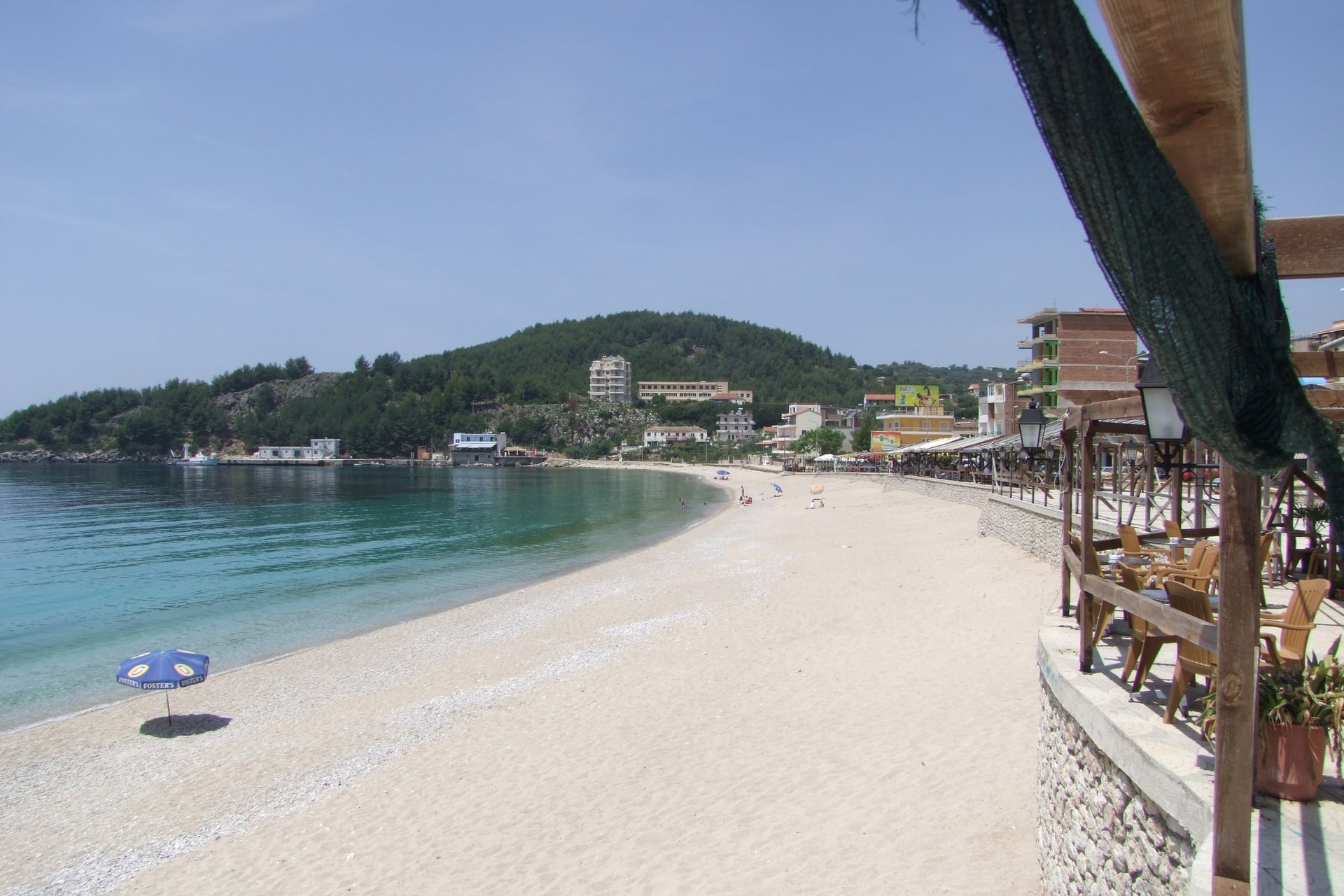
For most routes May, June and September are the best months, with long days and the beaches at Himarë and Dhërmi quieter than in the school holidays.
Know Before You Arrive
Most trips start at Tirana airport or on a ferry from Corfu, and the practical side comes down to cash, guesthouses and one lake ferry.
Getting There
Tirana's international airport has direct flights from London with British Airways, Wizz Air and Ryanair, while flights from the US connect through European hubs. The airport bus runs every hour, day and night, and takes 30 to 40 minutes to the city centre.
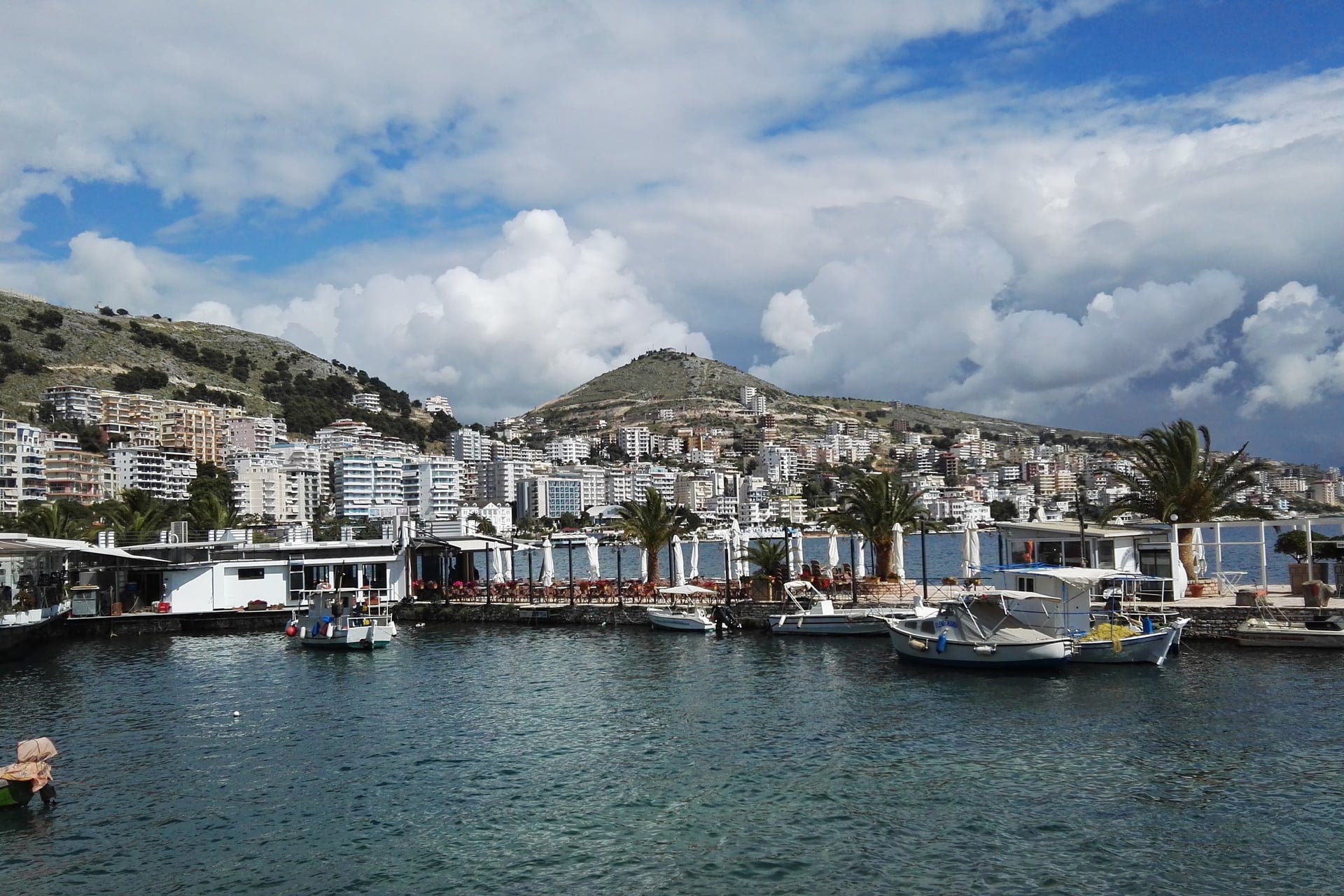
From Corfu: ferries to Sarandë take about 30 minutes and carry bikes
From Italy: overnight ferries from Bari reach Durrës in 8 to 10 hours, depending on the company
From Montenegro: the Hani i Hotit border crossing on the road from Podgorica to Shkodër
Visas: UK citizens can stay 90 days in any 180 without a visa, and US citizens up to one year
Where to Sleep
Outside the towns most nights are in family guesthouses, and in Theth (about 750 m) and Valbonë (about 930 m) half board is the norm because restaurants are few. Dinner and breakfast come with the bed.
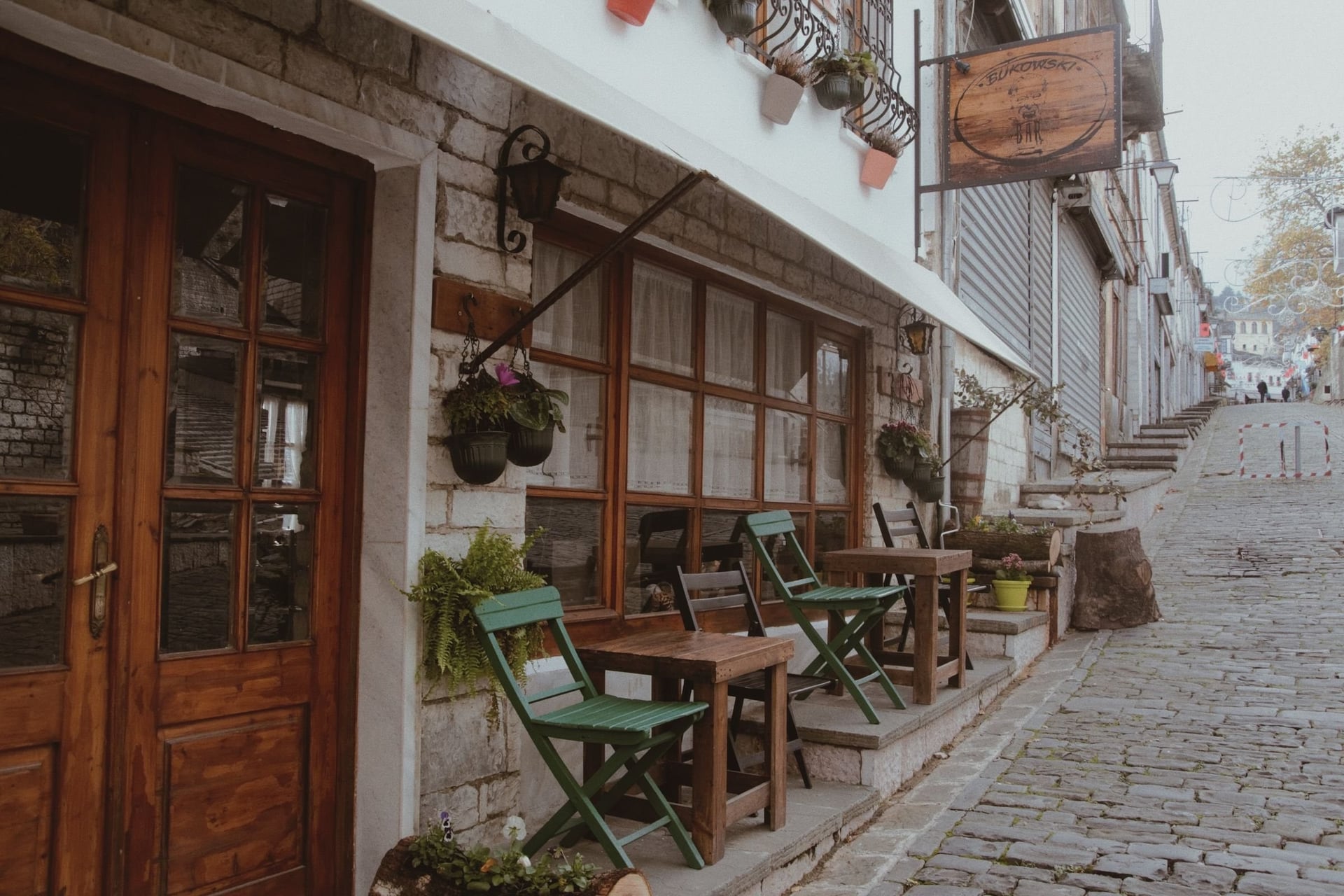
Mountain guesthouses follow the road season. From November to April or May most in Theth close and their owners move down to Shkodër, so plan mountain nights from May to October. In Berat and Gjirokastër, many guesthouses occupy old stone houses in the UNESCO quarters.
What to Eat on the Road
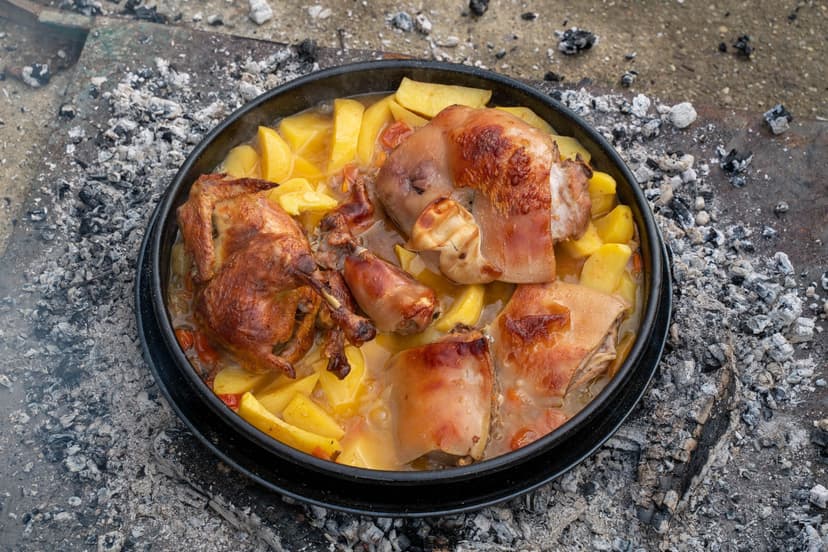
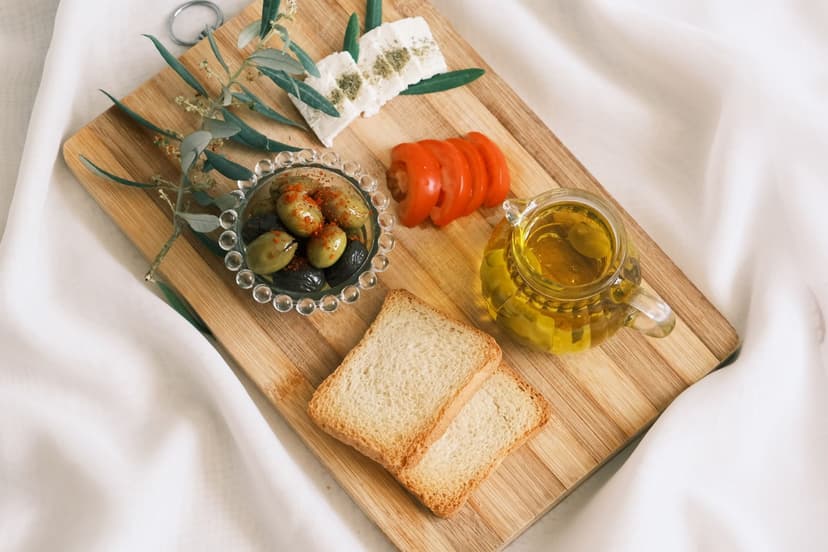
Albanian food suits long riding days. Byrek, the cheese or spinach pie every bakery sells from early morning, is the usual breakfast before a climb, and dinner is slow-baked and filling. These three are worth looking for along the way.
How Much Does It Cost?
Albania is cheap for eating out and sleeping, less so for groceries. In 2024 Eurostat put restaurant and hotel prices at 52% of the EU average, but food in shops at 100%.
Guesthouse half board: 2,000 to 3,500 lek (about €20 to €35) per person in Theth, highest in July and August
Coffee: 100 to 150 lek in a village café
Koman ferry (Berisha): 1,000 lek per person and 1,200 lek per bike in cash, or €8.80 and €10.60 online
Corfu to Sarandë ferry: €19 to €24 one way with Finikas Lines
Tirana airport bus: 400 lek to the city centre
Furgon (minibus) from Theth to Shkodër: about 1,200 lek, for riders who skip the climb back
Carry cash in lek, because card payment is rare in the mountains and Theth's only cash machine can run out.
What to Pack
Pack for heat at sea level and cold on the passes. In July the average high at Qafa e Thorës is about 20 °C, 13 °C lower than in Shkodër, and at the Llogara Pass it is 6 °C lower than in Vlorë.
For any ride in Albania:
Tyres of 32 mm or wider for broken asphalt and gravel side roads
Front and rear lights for unlit tunnels and early starts
A bell for village streets shared with people, dogs and livestock
Two spare tubes, tyre levers and a multi-tool, because bike shops are mostly in the cities
Cash in lek for guesthouses, cafés and the Koman ferry
Two large bottles and a filter for refills on hot days
Phone with the route's GPX file and a power bank
For the passes and the south:
Windproof jacket and full-finger gloves for the descents from Qafa e Thorës and Llogara
Low gears for the 14% ramps on Llogara's south side
Sun cream and electrolyte tablets for July and August in the southern valleys
Can You Cycle Albania Without Carrying Your Bags?
Yes, and on Albania's long mountain days it makes the biggest difference. Dardhë to Përmet is about 130 km with 2,000 m of climbing. The Riviera day from Himarë over Llogara to Vlorë gains 1,700 m in 70 km.
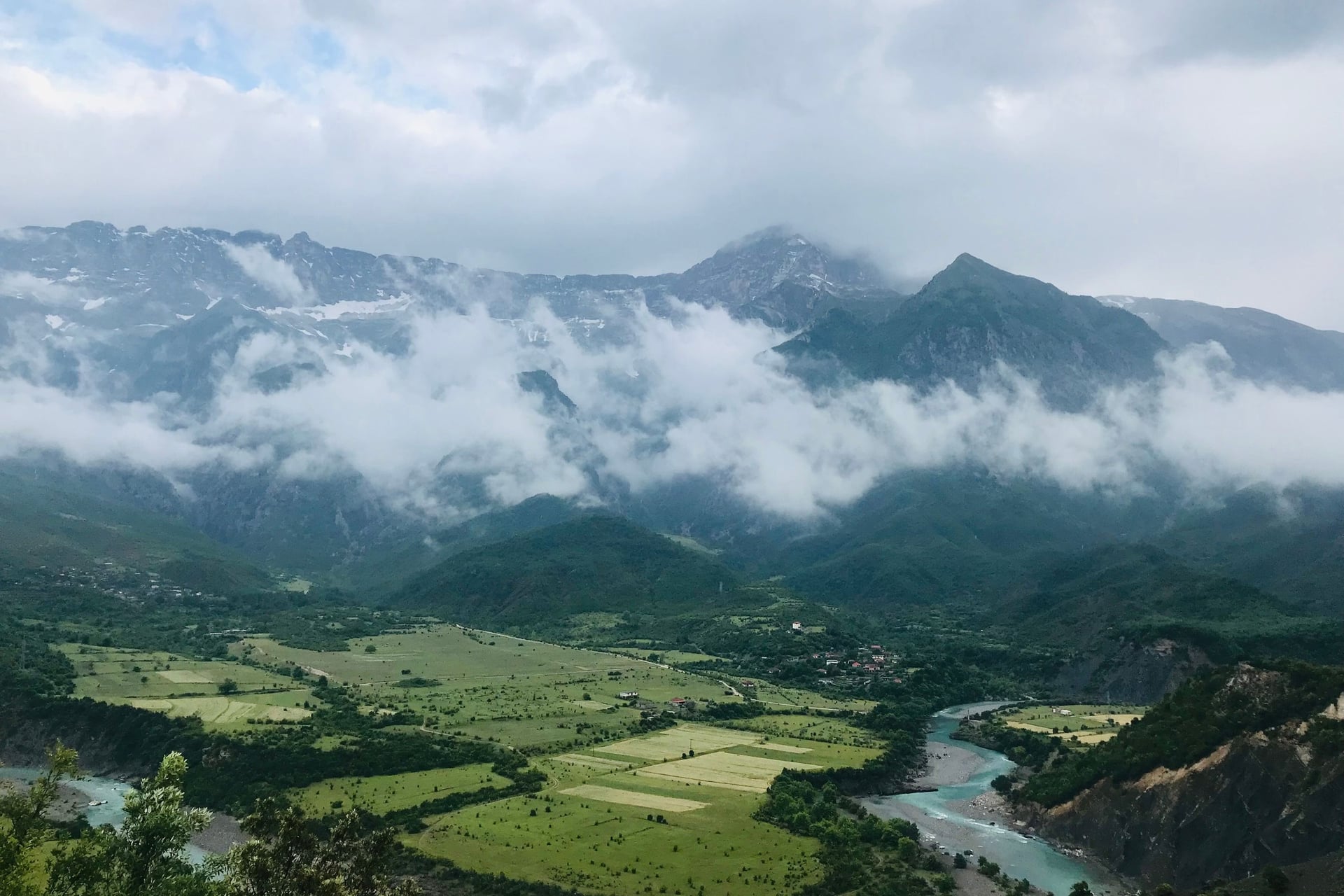
On those days a support driver who moves the luggage, and is there to help if the weather turns, means you climb with only a day bag. Our three self-guided tours book the hotels and move the bags on a cycling holiday in Albania.
Lakes, rivers and the Riviera: Albania UNESCO Cycling Tour, 10 days / 8 riding days from Struga to Vlorë, 475 km and 7,200 m, with a support driver and Tirana transfers
The north on the Trans Dinarica: Dinaric Cycling Route in Albania, 6 days / 4 riding days from Tamarë to Elbasan, 230 km and 1,920 m, with a support driver and Tirana transfers
Albania within the Balkans: Cycle the Balkans, 9 days / 7 riding days from Dubrovnik to Podgorica, two of them around Lake Shkodër; luggage moved, no support driver
All three run from April to October and include 3-star hotels with breakfast, the digital guidebook, the GPS app and support during the tour. Ask us about dates for next season. The full list of our Albania tours has prices and departures.
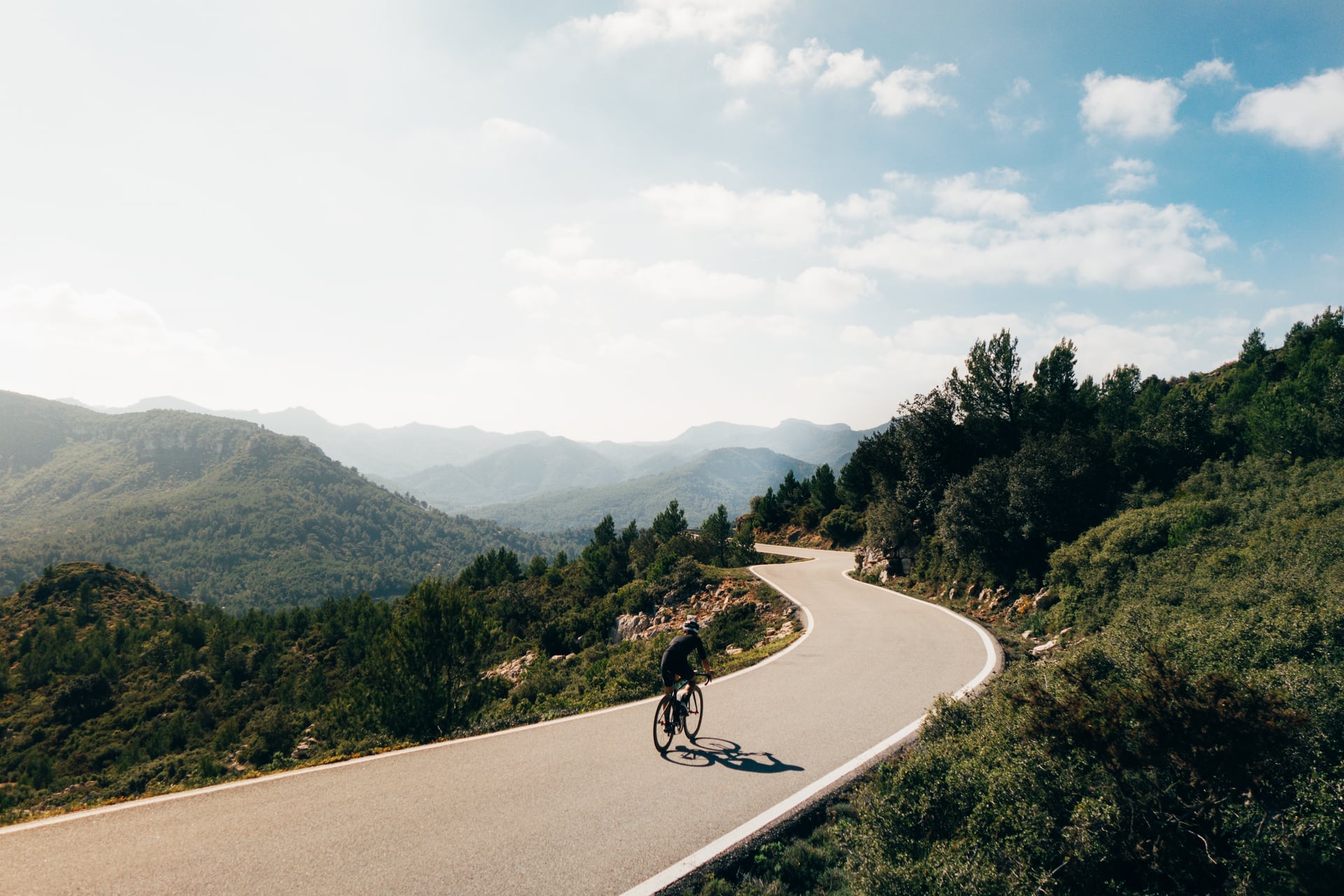
From the top of the Llogara Pass the road drops 1,027 m in hairpins to the Bay of Vlorë, the last descent of a crossing that began on the shore of Lake Ohrid.
Frequently Asked Questions

Plan with a cycling expert
Free advice from a team that knows these routes inside out - real people, not a bot

Hassle-Free
We take care of route planning, accommodations, luggage transfers, and all logistics, so you can focus purely on enjoying your ride.

Tried & Tested Adventures
Our cycling routes are hand-picked & tested, to ensure breathtaking landscapes, smooth roads, and maximum safety - giving you the perfect ride every day.

Unbeatable Support
Our 24/7 customer support is where we show our passion, ensuring your cycling holiday runs smoothly and your well-being is always our top priority.

Book with Confidence
We are a financially protected company, fully bonded and insured, keeping your money safe and allowing you to travel with confidence.